
2018/11/19 11:34:03
比利时鲁汶,2018年11月19日 — 在imec日本科技论坛(ITF Japan 2018)上,世界领先的纳米电子和数字技术研究与创新中心imec、根特大学(UGent)和隐形眼镜制造商SEED Co., Ltd.宣布:他们已开发出带有集成LED灯的隐形眼镜,包括超薄硅微芯片、用于无线供电的射频(RF)天线和可拉伸的薄膜互连。传统的隐形眼镜型可穿戴设备由非含水材料制成,而这种新型设备由基于水凝胶的材料制成。这是有史以来自动电子装置在水凝胶软镜片中的首次展示,为各种独特的应用打开了大门,例如带有传感器和/或药物输送系统的镜片,用于治疗先天性、手术后或创伤级等不同的眼部疾病。这种装置的主要优点是它们的侵入性低,并且能以几乎难以察觉的方式连续监测。
Imec, Ghent University and SEED Demonstrate Electronics in Hydrogel-based Soft Lenses
LEUVEN (Belgium), November 19, 2018 — At the imec technology forum Japan (ITF Japan 2018), imec, the world-leading research and innovation hub in nanoelectronics and digital technologies, the Ghent University (UGent), and contact lens manufacturer SEED Co., Ltd. announced that they have developed a contact lens with an integrated LED light, including an ultra-thin silicon microchip, radio‐frequency (RF) antenna for wireless energy transfer, and stretchable thin‐film interconnections. Different from the traditional contact lens-type wearable devices made of non-water-containing material, this novel device is made of hydrogel-based material. This demonstration of autonomous electronics in hydrogel-based soft lenses opens the door to unique applications such as lenses with sensors and/or drug-delivery systems for the treatment of different eye disorders, at the congenital, post-surgery or trauma level. The main advantages of such devices are their low invasiveness level and continuous monitoring in an almost imperceptible manner
About 130 million people worldwide wear contact lenses, mainly to correct their vision. Now, with electronic systems getting ever smaller and with the possibility of having electrical power on-lens, it becomes feasible to integrate a variety of transducers (i.e. physical, biochemical, etc.) into a lens. This is interesting for diagnosing and treating ocular diseases. The challenge is to integrate a complete autonomous system and make it as flexible as a soft lens, without compromising its oxygen-permeable nature and the integrity of the electronics components.
CMST, an imec research group at Ghent University, together with SEED Co., Ltd., demonstrated a semi-passive smart lens with blue LED light powered by an RF coupling. Besides power transfer, the RF link can be used to calibrate the integrated transducers and reading the sensors out into a handheld device for further post-processing. The spherical‐shaped electronics were made by imec/CMST, whereas SEED Co., Ltd. was responsible for the seamless integration into the hydrogel-based soft lens. The interconnect substrate is based on thermoplastic polyurethane (TPU), a material with a low glass transition temperature, relatively low hardness, proven biocompatibility, optical transparency, conformal fitting, oxygen permeability, and flexibility comparable with soft contact lenses (e.g., hydrogel‐based). Moreover, the viscoelastic nature of TPU allows planar structures to be thermoformed into spherical caps with a well‐defined curvature (i.e., eye's curvature at the cornea: 9 mm). Very precise fine‐tuning of the thermoforming parameters and optimization of strain‐release patterns enabled to achieve oxygen permeable, thin, non-developable, and wrinkle‐free contact lenses with integrated electronics. Well chosen gaps in the circuit provide for oxygen permeability of the lens.
“Flexible and stretchable electronics hold a lot of promise for medical applications,” explains Andrés Vásquez Quintero, imec researcher and professor at UGent. “They can be integrated in intelligent clothing, and even – when combined with highly miniaturized electronics – in smaller devices such as contact lenses. Major challenges have to be overcome to make a truly autonomous smart lens which is comfortable to wear and stable for a few days or even weeks. The integration of a LED light in a semi-passive RF wireless platform is the first important step towards a device that will change the life of many.” Following steps will focus on developing active lenses with extended power autonomy in order to drive and readout the integrated transducers and on the design of micro-transducers compatible with stretchable systems similar to the one presented here.
“With this technology, contact lens-type wearable devices could be mass produced as those existing contact lens products.” States Ms. Arai, researcher at SEED Co., Ltd., one of the developers of the device. “Moreover, the device could be installed on the outer side (tear film side), the inner side (cornea side), or in the center part of the contact lens. The adjustability of location is valuable for the biosensing field. Also, the possibility of mass production indicating the possibility of disposability, which makes the contact lens-type wearable devices more approachable to the patients around the world, and should contribute to their quality of life.” From now on, the R&D group is dedicating to the development of contact lens material for biological monitoring.
—end—
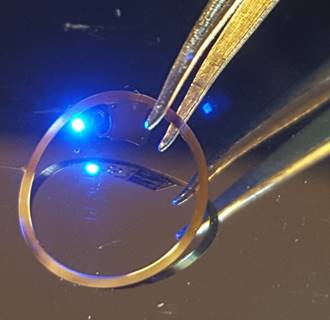
Figure 1: Self-standing flexible RF antenna with thin microchip, LED light and stretchable interconnections.
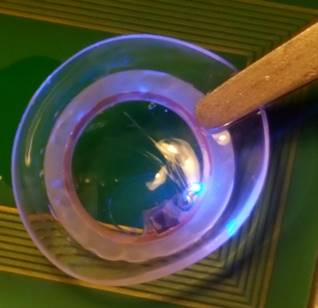
Figure 2: Semi-passive hydrogel-based smart contact lens powered up by an RF wireless coupling.
声明:本网站部分文章转载自网络,转发仅为更大范围传播。 转载文章版权归原作者所有,如有异议,请联系我们修改或删除。联系邮箱:viviz@actintl.com.hk, 电话:0755-25988573

